Reflective writing is a practice that allows writers to delve deeply into their thoughts, experiences, and insights. It is essential for personal growth, self-awareness, and professional development. Reflective writers often need to explore complex ideas and connections, making the process both introspective and nonlinear.
Traditional note apps like Evernote and OneNote have gained popularity due to their ease of use and organizational capabilities. They are widely used by students, professionals, and hobbyists for quick note-taking and information storage.
However, reflective writers face significant challenges when using these traditional note apps:
- Limited support for nonlinear thinking: Traditional note apps typically rely on linear organization systems such as lists or hierarchical folders. This structure can stifle the creative flow required for deep reflection.
- Inadequate tools for deep introspection: Reflective writing often involves exploring intricate connections between ideas. Traditional note apps lack features that facilitate this level of introspection.
These limitations hinder the ability of reflective writers to capture their evolving thoughts effectively.
Why Traditional Note Apps Don't Work for Reflective Writing

Standard note apps simply don't meet the needs of deep writing workflows. These tools, which are built around document editing and linear folders, create unnecessary limits on how we can record and access our thoughts. This is especially problematic for reflective writers, who think in interconnected ways rather than straight lines.
The Problems with Standard Apps:
1. Linear Organization
Most note apps are designed to resemble physical notebooks or digital documents. Each note is stored in a folder or exists within a single document, forcing ideas into rigid hierarchies that rarely capture the fluid nature of deep reflection.
2. Limited Connectivity
Connections between notes are usually manual and cumbersome. Moving from one idea to another requires opening multiple documents, searching for links, or tagging each entry repeatedly.
3. Static Structure
As reflections evolve, updating earlier insights or weaving new meaning across separate notes becomes labor-intensive. The system resists the dynamic structure that reflective writing naturally requires.
Our brains don't store thoughts in folders; instead, they connect concepts across different contexts, forming networks that expand as our understanding grows.
For anyone looking to capture evolving insights, explore tangents, or revisit previous thoughts with a fresh perspective, the flaws of linear organization systems quickly become apparent. Complex thought patterns lose their richness when forced into flat lists or unchanging folders—a significant obstacle for writers seeking depth and connection in their reflective practice.
Key Challenges Faced by Reflective Writers with Traditional Note Apps

Reflective writing thrives on depth, flexibility, and the ability to capture complex trains of thought as they unfold. Traditional note apps consistently fall short in several critical areas, directly impacting the reflective process.
1. Lack of Support for Long-Form Writing
Most mainstream note-taking apps are designed for quick jotting and task-based lists. Attempting to draft nuanced reflections or in-depth explorations within these apps quickly becomes cumbersome.
Example: Typing a multi-page meditation on a life experience often feels cramped within Google Keep or Apple Notes. The limited formatting options make it difficult to structure paragraphs, add emphasis, or build out an extended narrative.
Implication: The reflective writer is forced to break ideas across multiple short notes, disrupting flow and making it harder to sustain the kind of immersive self-inquiry that defines meaningful reflection.
2. Limited Organizational Tools
Traditional apps usually rely on simple folder structures or flat tag systems. This approach struggles to keep up with the way thoughts evolve and interconnect during reflection.
Example: After several weeks of daily journaling in Evernote, finding meaningful connections between past entries requires constant manual tagging and sorting. There’s no automatic recognition of themes or relationships between notes.
Implication: Insights that develop over time become buried or fragmented, reducing the likelihood of discovering patterns or revisiting important ideas when they’re most needed.
3. Minimal Multimedia Integration
Reflective writing often extends beyond text—images, audio snippets, voice memos, and sketches can capture moods and insights that words miss. Most traditional note apps offer little beyond basic image attachments.
Example: Recording a voice memo after a meditative walk or attaching a photo that inspired a moment of realization often feels like an afterthought in standard note apps. There’s no seamless way to integrate these media types into the narrative flow.
Implication: The richness of lived experience gets flattened into plain text, erasing layers of meaning and memory that could fuel deeper reflection.
4. Poor Searchability and Retrieval
As reflective notes accumulate, retrieval becomes critical. Basic keyword search is often the only option provided by traditional note apps.
Example: Searching for all reflections related to “personal growth” might return dozens of unrelated notes if tagging was inconsistent or if related concepts use different language. There’s no semantic understanding—just literal string matches.
Implication: Valuable insights become lost in digital clutter. The inability to resurface relevant past entries stifles iterative learning and prevents knowledge from compounding over time.
Without robust support for long-form content, dynamic organization, multimedia integration, and intelligent retrieval, traditional note apps create friction at every turn for reflective writers seeking clarity and growth through their practice.
Shifts toward tools that can accommodate nonlinear thought patterns and richer forms of self-expression signal a new chapter for anyone committed to deep introspection.
Essential Features Required for Effective Reflective Writing Tools

Reflective writers need tools that capture the full depth and nuance of their thought process. Traditional note apps often restrict users to text-based, document-centric workflows, which can dilute the richness of introspection and slow down the creative flow. Key features that truly support reflective writing focus on multimedia integration, organizational flexibility, and robust searchability.
Multimedia Integration
Rich reflections come in many forms—text, sketches, voice memos, photos, web clippings.
Writers often want to add context by capturing a fleeting idea as a voice note or snapping an image of a whiteboard from a brainstorming session.
A reflective writing tool should allow seamless embedding of audio recordings, images (with OCR support for searching handwriting), and quick web captures to build a holistic record of thoughts.
Traditional note apps typically silo content types or make it cumbersome to reference mixed media within a single reflection.
Organizational Flexibility
Reflective thinking rarely follows a linear path. Ideas branch, loop back, and form complex networks.
Tools designed for document-based editing lock notes into folders or rigid hierarchies, mimicking physical paper but neglecting the brain’s nonlinear structure.
Graph-based organization—where notes exist as nodes on an infinite canvas—mirrors how thoughts connect in real time. Drag-and-drop linking, visual mind maps, and open-ended canvases offer freedom to group and regroup insights as understanding deepens.
The ability to rearrange and reconnect ideas visually supports ongoing synthesis rather than static archiving.
Powerful Searchability
Deep reflection depends on surfacing past insights at exactly the right moment.
With traditional note apps, even carefully tagged notes can vanish into digital piles if search is slow or unintuitive.
Effective tools leverage AI-driven search engines that recall relevant notes instantly as you type or speak—filtering by similarity, context, or tags without manual digging.
Instant recall enables writers to spot patterns across months or years of entries without breaking their train of thought.
Multimedia integration, organizational flexibility, and powerful searchability are not luxuries—they are necessities for any tool aiming to support serious reflective writing. With these features in place, writers find themselves liberated from the constraints of traditional note apps and able to explore their inner landscape more deeply.
The Rise of Digital Journaling Platforms as a Solution

Reflective writers are turning to digital journaling platforms that use modern technology to overcome the limitations of traditional note apps. These tools directly address the needs for flexible organization, support for various media types, and easy access to insights.
Key advantages of digital journaling platforms:
- Visual mapping capabilities allow users to see connections between entries, encouraging deeper exploration of ideas.
- AI-powered search and suggestion engines surface relevant past notes as you write, minimizing the risk of lost insights.
- Multi-format input: voice memos, image uploads, and web clippings become part of your knowledge base with minimal friction.
Modern technology embedded in these platforms enables reflective writers to structure their thoughts in ways that mimic natural cognition—fluid, interconnected, and context-rich. This new generation of tools is shaping how reflection becomes actionable knowledge.
Constella App: A Game-Changer for Reflective Writers
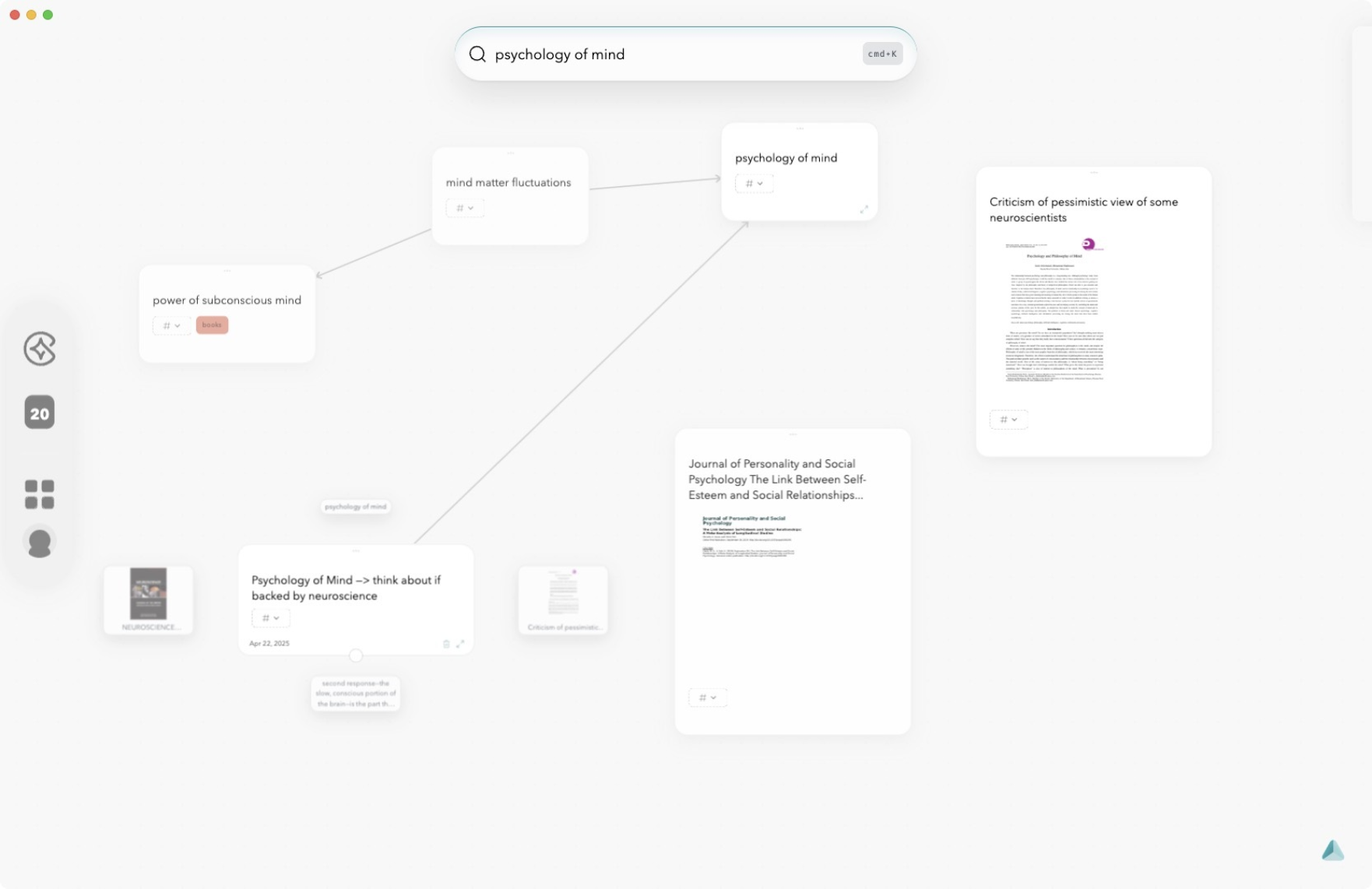
The Constella App is a revolutionary tool designed specifically for reflective writers. Unlike traditional note apps, Constella offers a visual graph-based approach to note-taking, allowing users to organize their thoughts in a way that reflects how our minds actually work.
Unique Features of Constella App
- Smart Retrieval System – Uses AI-powered, similarity-based search (combined with keyword search) to surface related notes instantly as you type, dramatically reducing time spent hunting for previous entries.
- Visual Graph Interface – Provides an infinite, zoomable canvas where individual notes are displayed as interconnected nodes, allowing dynamic mapping of ideas without rigid document structures.
- Stella AI Assistant – A built-in AI chat assistant that interacts with your notes, files, and visual connections to summarize content, answer questions, generate outlines, and help organize information contextually.
- OCR & File Upload Support – Lets you upload PDFs and images and integrates the content fully into the searchable graph.
- Task Management Integration – Includes task creation and management features: you can add to-dos with due dates directly in your notes, link them to projects, and view tasks in context within the graph interface.
Constella brings together powerful tools for capturing, connecting, and acting on your thoughts—all in one intuitive, visual space. For reflective writers looking to deepen their thinking and streamline their workflow, it offers a flexible and intelligent alternative to traditional note-taking apps.
Conclusion
Reflective writing thrives when your tools adapt to the nonlinear, layered nature of human thought. Relying on a traditional note app often means forcing your ideas into rigid, linear structures that stifle discovery and diminish the value of deep introspection. For anyone seeking the best note app for reflective writers, flexibility and context-driven organization aren’t optional—they’re essential.
Constella App stands out as a visual notes app designed for how your mind actually works. Its AI-powered features—such as smart retrieval, instant contextual suggestions, seamless visual mapping, and interconnected note graphs—transform random fragments into meaningful insights. The Stella AI assistant makes it effortless to surface forgotten connections or generate new perspectives from existing notes.
Traditional note apps merely store information; Constella helps you evolve it.
Choosing a tool that supports nonlinear thinking processes unlocks richer, more authentic self-reflection. With Constella’s graph-first approach and intelligent assistance, you gain the freedom to explore, connect, and revisit your thoughts in ways that truly support personal growth. For anyone serious about reflective practice, Constella isn’t just another app—it’s a catalyst for deeper understanding and continual learning.
FAQs (Frequently Asked Questions)
What is reflective writing and why is it important for writers?
Reflective writing is a process where writers explore their thoughts, experiences, and feelings to gain deeper insight and understanding. It is important because it fosters critical thinking, personal growth, and enhanced creativity, which are essential for meaningful writing.
Why do traditional note apps fall short for reflective writers?
Traditional note apps often rely on linear organization systems that limit the ability to capture complex, evolving ideas. They lack support for nonlinear thinking and deep introspection, which are crucial for reflective writers seeking to explore and connect diverse thoughts.
What challenges do reflective writers face when using traditional note apps?
Reflective writers encounter several challenges with traditional note apps including lack of support for long-form writing, limited organizational tools, minimal multimedia integration, and poor searchability. These issues hinder the depth and quality of reflections by restricting expression and retrieval of insights.
What essential features should effective reflective writing tools have?
Effective reflective writing tools should include multimedia integration to capture rich reflections, organizational flexibility to accommodate nonlinear thinking patterns, and robust search functions to enhance accessibility to past insights. These features support a more dynamic and thorough reflective process.
How do digital journaling platforms address the limitations of traditional note apps?
Digital journaling platforms leverage modern technology to offer flexible organizational structures, multimedia support, and advanced search capabilities. They provide an environment better suited for nonlinear thinking and deep introspection, overcoming many constraints of traditional note-taking applications.
What makes the Constella App a game-changer for reflective writers?
Constella App stands out with its AI-powered smart retrieval system and visual graph-based notes that facilitate nonlinear organization of thoughts. These unique features cater specifically to reflective writers by enabling deeper exploration, better organization, and easier access to complex ideas compared to conventional note apps.
Want more insights like this?
Subscribe to get short productivity tips and useful summaries of new tools every week.
Want more insights like this?
Subscribe to get short productivity tips and useful summaries of new tools every week.